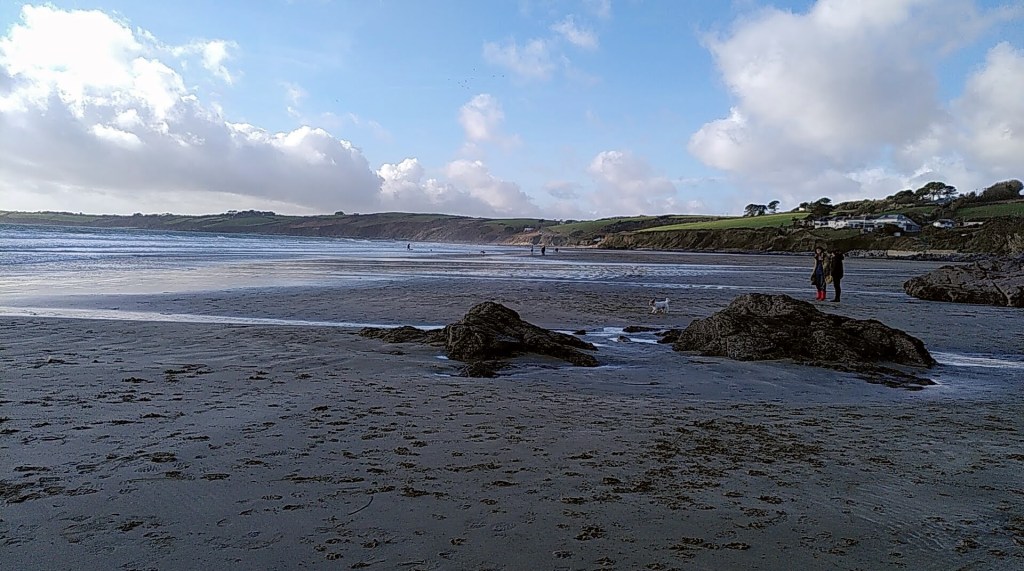
As an Impact, Development and Partnership Manager at the University of Exeter, I worked with local businesses in Cornwall to provide support to move towards more sustainable and circular business models. Cornwall, a peninsula in the Southwest of England, is a beautiful but deprived part of Europe. Despite this, it’s a place where innovation thrives.
Cornwall has a population of just over half a million people. With its rugged coastline, beautiful beaches, windswept moorland and traditional fishing villages, it is a beautiful place to live and work. The economy is entwined with natural assets and the extraction of natural resources: tourism, mining, agriculture, forestry and fishing. As with many rural and coastal communities, there are challenges too. The work is often seasonal and low paid. Children ‘learn to leave’ Cornwall if they want to get on in life. There is considerable social and economic deprivation. It was because of these factors that we received funding for Arca: the region is one of the most economically deprived areas of the UK and Europe and is defined as a ‘less developed region’ with a GDP per inhabitant less than 75% of the EU average.
Yet, despite – or because of – these factors, it is a place where entrepreneurship and the desire to use business as a vehicle to deliver social and environmental justice thrives. Here is a taste of the circular economy in action in Cornwall.
Skinflint
Skinflint are Europe’s leading vintage industrial lighting site. They source and restore historic vintage lights. This reduces waste as well as giving their customers the opportunity to enjoy a beautiful and unique light fitting.
Oltco
Using low-grade recycled plastics, Oltco developed Recycle Bound as an alternative to traditional tarmac. Recycle Bound can be used to create hard-wearing, porous surfaces for paths and driveways. Their work was inspired by noticing how much plastic pollution is now washed up on the beaches where they used to play as children. They wanted to do their bit to restore these spaces for their kids and turn plastic waste into a valuable resource.
Chocolarder
Chocolarder are an artisan chocolate maker based in Porthleven, Cornwall. Every element of their business is circular – designed to minimise waste and environmental impacts, as well as deliver social justice. From organically grown beans transported across the Atlantic by sail to bars manufactured with refurbished vintage equipment to adding waste orange peel sourced from a local beachside café, they have thought through every element of their business model to minimise harm and maximise social and environmental benefits. And the chocolate tastes great too!
Bennamann
Bennamann’s innovative technology captures fugitive methane emissions from slurry pits (cow dung) and uses it to create a fuel with the added bonus of a soil conditioner as a by-product. Methane is a highly potent greenhouse gas so turning this waste product into a valuable fuel creates win-win scenario which epitomises the circular economy principle of using waste as a resource. For cash strapped farmers having autonomy over their fuel supply – with potential to go off-grid – is a welcome additional benefit.
Flexi-Hex
Flexi-Hex creates plastic-free, biodegradable packaging for a wide range of industries – board sports, bottles, cosmetics, electronics and homeware. If you think cardboard, doesn’t sound like a strong enough material for packaging delicate items, watch the drop test video. The unique hexagonal design is tougher than you’d think.
Newquay Orchard
Newquay Orchard is a seven-acre community space in the centre of Newquay which offers educational, social and volunteering programmes to help the local community. This inspirational organisation restores nature whilst replenishing the spirit.
Find out more about the circular economy.


Leave a Reply