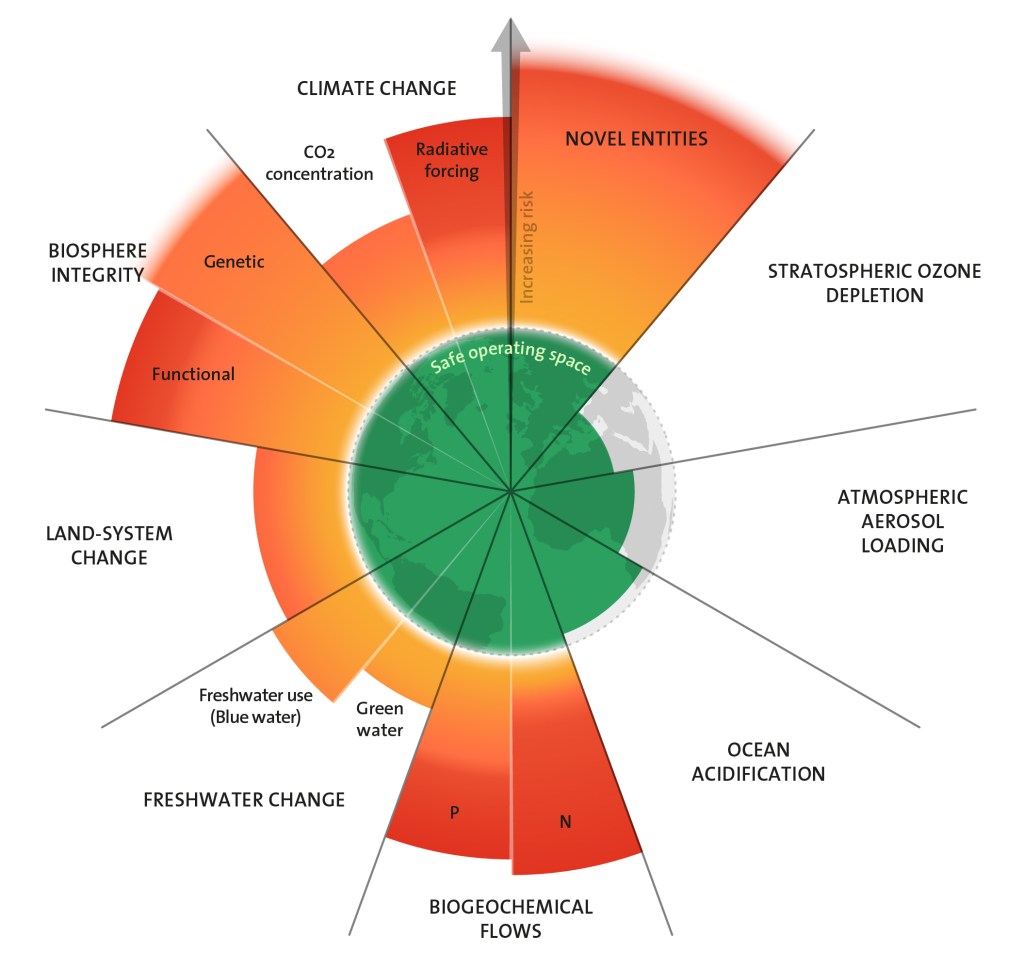
Planetary boundaries aren’t a new concept but if you haven’t heard of them yet, the idea is worth getting to grips with as it’s a really useful way to understand, quantify and visualise human impacts on the environment.
In 2009, Rockström and a team of 28 internationally renowned scientists (Rockström et al. 2009) identified nine Earth system processes which underpin human flourishing:
- Climate change: the change in ratio between incoming and outgoing energy of the Earth caused by increases in greenhouse gases and aerosols which increase global temperatures and alters climate patterns.
- Novel entities: the introduction of synthetic substances, such as, microplastics, nuclear waste and GMOs.
- Stratospheric ozone depletion: the condition of the ozone layer which protects life on Earth from harmful ultraviolet radiation.
- Atmospheric aerosol loading: airborne particles from human activities or natural sources which can influence the climate by altering temperatures and rainfall patterns.
- Ocean acidification: increasing acidity in ocean water due to the absorption of atmospheric carbon dioxide.
- Biogeochemical flows: the disruption of essential nutrient cycles of key elements like nitrogen and phosphorous.
- Freshwater change: the alteration of freshwater cycles, including rivers and soil moisture.
- Land-system change: the transformation of natural landscapes, for example, through deforestation and urbanisation.
- Biosphere integrity: the decline in biodiversity.
It’s called the ‘planetary boundaries’ framework because as well as identifying these key processes, the research team quantified the thresholds (or boundaries) which indicate these systems are healthy and functioning or conversely are at risk. So just like the medical profession has identified a typical temperature which indicates the human body is sick, crossing the planetary boundaries indicates that these Earth systems or processes are not in a healthy state. These thresholds and the extent to which we have crossed them have been visualised in the diagram above.
Now, six of the nine planetary boundaries identified have been crossed (Richardson et al. 2023):
- Climate change
- Novel entities
- Biogeochemical flows
- Freshwater change
- Land-system change
- Biosphere integrity
These systems are necessary to human survival. Crossing these boundaries threatens the stability human civilisation needs to flourish.
Since the last major ice age, approximately 10,000 years ago, we’ve had a pretty good run of in terms of the stability of our planet. This period, called the Holocene, has enabled civilisations to develop, grow and flourish. It’s probably the same for you in your life, whilst moments of crisis can be the catalyst for change, it’s most likely that it is the periods of stability in your life which have enabled you to grow and build your career or your family, for example. When you’re lurching from one crisis to another, this takes a lot of energy and so it’s hard to flourish. Majorly destabilising events such as natural disasters or war do not help people to thrive, as the focus narrows to one of survival. It’s the same at a planetary and species level. The equilibrium of the Holocene (for example, the stable climate) meant human civilisations could develop – ideas, industry, science, technology, transport, language, writing, economies, agriculture, art, culture, mining, political institutions, educational establishments and leisure could all flourish in unprecedented ways.
The Planetary Boundaries model recognises this by describing the zone within the thresholds as the ‘safe operating space for humanity’. This is the space where we can flourish. Focusing our energy on bringing these systems back within safe limits in is in all our interests.
You can find out more about the Planetary Boundaries model by:
- visiting the Stockholm Resilience Centre
- watching the excellent Netflix documentary – Breaking Boundaries: The Science of Our Planet
- taking a look at the Planetary Health Check
 Wylder Earth
Leave a comment