
The food system is the everything and everybody that influences – and is
influenced by – food. That’s a lot people and a lot of things! It’s a very complex system which can be framed in many different ways. Here’s one way the Centre for Food Policy defines the food system in its briefing paper – What is the Food System?
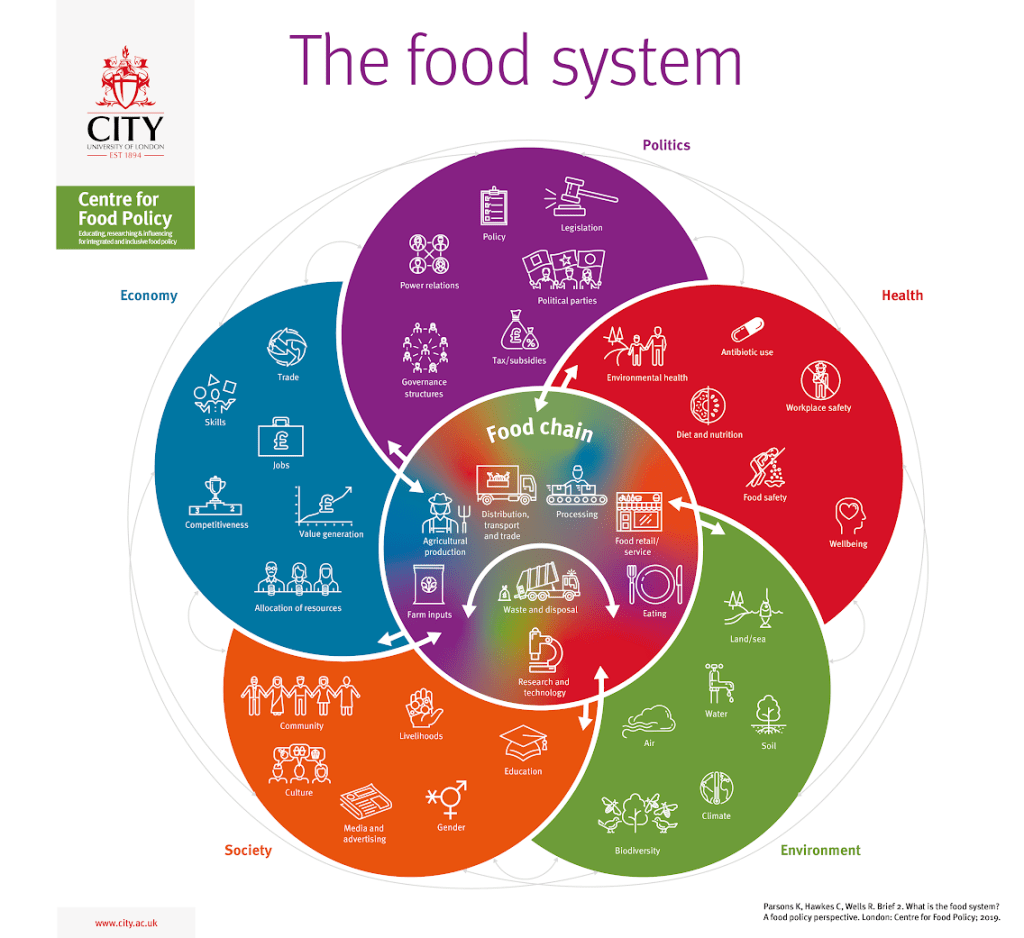
The food system can be defined as all the activities involved in the food supply chain from farm to fork or more accurately farm to flush – because the waste material from food is a fundamental part of the system.
Food needs to be produced – grown, gathered, harvested or slaughtered. Then it’s processed – cut, cleaned, canned, transported, perhaps taken to a factory to be made into another product. It’s marketed, traded, sold. Then eaten – at home, at school, at university, in a kitchen, cafe or canteen. And then there’s the waste that needs to be disposed of.
In the above diagram, the food system is framed as impacting five different interconnected dimensions:
- Economics. The food system is an economic system. Food is bought and sold. It generates jobs and value. Consumers engage economically with the food system through their consumer choices when they buy food. Within these economic relationships, there is inequality between those with power and those without. Farmers typically receive very little share in the value of the food they produce and low paid seasonal work is common within the agri-food sector.
- Politics. Food is political. Food policy creates the rules in which the food system operates and influences market forces through taxes and subsidies. Food has long been politicised and weaponised. It’s been used to undermine, disempower and kill off threats and enemies.
- Environment. Food production is explicitly entwined with the environment. Agriculture is dependent on water, soil and climate. Conversely, how we produce food impacts the environment, contributing to climate change and using vast amounts of freshwater for irrigation. Our current industrial agricultural system is undermining the natural resources upon which it depends.
- Health. Food nourishes us. It enables us to live, grow and feel good. It is essential for our survival and integral to our wellbeing. But food is also associated with ill-health, from malnutrition to obesity and non-communicable diseases associated with poor diet: heart disease, diabetes and cancers.
- Society. Food isn’t just functional, it’s a core part of our identities. Food creates community cohesion, brings families together and is the focal point of cultural and religious festivals worldwide.
Mapping the different dimensions of the food system in this way illuminates the interconnections between different dimensions. Leverage points – places where one can intervene in the system to have maximum impact across different spheres – can be identified and potential unintended consequences can be spotted and averted. This holistic approach enables effective food policy solutions to be created.
You can find the full policy briefing document here: City Research Online – Brief 2: Understanding the food system: Why it matters for food policy
 Wylder Earth
Leave a comment