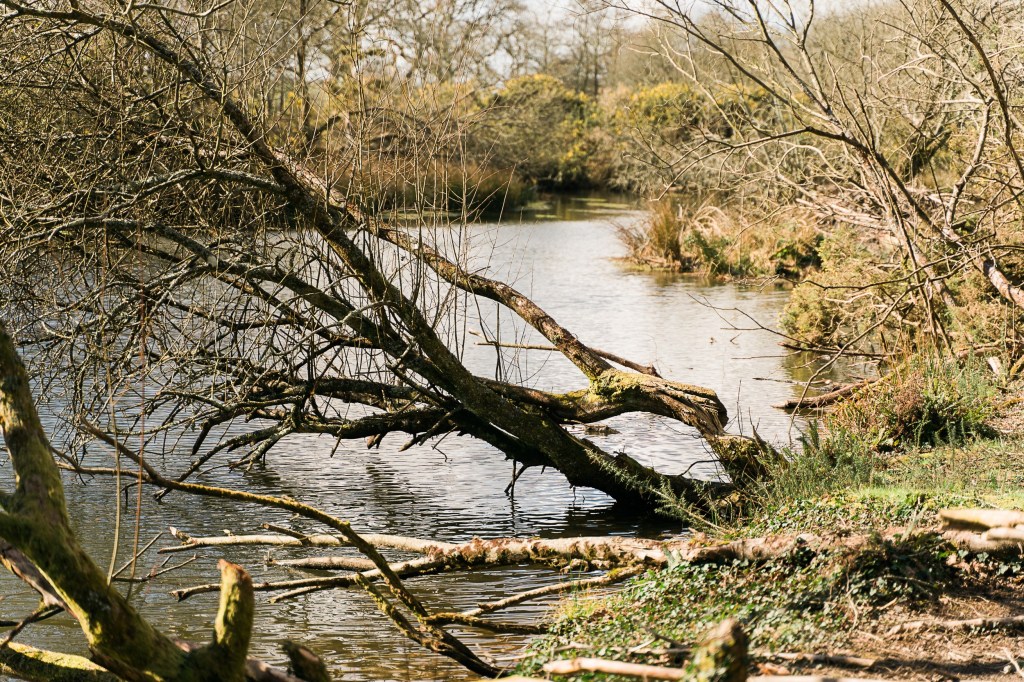
My interest in regenerative agriculture was sparked when I met Chris Jones from Woodland Valley Farm, a 170 acre mixed farm, providing organic beef for direct local sales. As well as farming along agroecological principles and being a founder member of The Pasture-Fed Livestock Association (PFLA), Chris’s farm is home to Cornwall Beaver Project giving me the opportunity to learn about the benefits (and challenges) of reintroducing beavers to Cornwall.
Photo credits: Michelle Coxall
It’s late spring, early summer and it’s the first time I’ve visited Chris. I’m sitting on a log next to a pond created by beavers. It’s getting a little cold by the pond. Dusk is falling and the air is starting to get damp, but I haven’t noticed because I’m listening intently to what Chris is telling me. The beaver pond is part of a research project, run by the University of Exeter, to understand the impact of the reintroduction of beavers.

In 2017, a pair of beavers was introduced onto the farm in an enclosure. It’s only a few years later but the impacts are clear to Chris. He calls the beavers ‘ecosystems engineers’. The beavers gnaw at trees and drag them into the water to create dams which then create pools of water. This helps protect their nests (or lodges) by surrounding them with water and ensuring the entrances are underwater. In effect, they’re building a moat for their castles. The beavers ‘engineer’ their surroundings in a way that suits them and helps to keep them – and more importantly their families – safe.
The beavers’ actions – as do everyone’s – have ripple effects. The beavers create habitats for other animals – fish and insects – which in turn attract birds. Through engineering the physical landscape, the beavers engineer and regenerate an entire ecosystem, improving biodiversity.

And there’s more: through building dams beavers slow the rate of water flow over the land. This is good news if you live in the village in the valley downstream. With climate change increasing the frequency and severity of extreme weather events, the beavers are helping the mitigate the impacts.
I start to notice how cold I am and that the damp from the log I’m sitting on is seeping into my jeans, but I still don’t want to move because now Chris is telling me about the way he manages the farm using regenerative practices.
Again, the message is clear: everything is interconnected, so one small change can have multiple beneficial impacts. Chris’s cows graze on herbal leys, a mixture of many different species of plants. In itself, this increases (plant) biodiversity, but it also leads to increases in biodiversity for other species, such as, insects and birds.

Many of the plants in the mix have deep roots. This helps to sequester (lock) carbon in the soil. As the plants grow and die back, carbon is drawn from the atmosphere into the plants through the process of photosynthesis and then this organic plant matter (carbon) accumulates in the soil.
“We have doubled the amount of soil organic matter in in the soil in the last 10 or 12 years.” Chris explains.

Increased soil organic matter mitigates the impacts of climate change – after all, climate change is driven by burning fossil fuels which are organic matter previously locked into the earth in the form of coal and oil.
Increasing soil organic matter, also helps with adapting to the impacts of extreme weather events associated with climate change. More organic matter in the soil helps create a sponge-like effect, absorbing water into the soil and slowing the rate at which it flows over the surface. This makes the area less susceptible to flooding and helps more water be available to plants in time of drought.
A further benefit is that slowing the rate of water flow over the surface of the soil helps to prevent the topsoil being washed away (i.e., soil erosion), keeping the nutrients on the farm where the farmer wants them and not in the nearby rivers where they become a pollutant.
And finally, because the plants have deep roots, they’re able to reach nutrients which other plants wouldn’t be able to and where do these nutrients go. Why into the cows, of course? So, the meat we eat is more nutrient dense – it’s better for us.
As Chris says, “The sheer weight of biology in that soil creates a soil which is fertile. So, with very little intervention we can boost the amount of grass that we grow and so make the food that comes off it really, really, really good.”

Healthy soil, healthy plants, healthy cows, healthy ecosystems, healthy us. It’s all interconnected. It’s a living system and we are part of it. We depend on it.
Despite the cold (I’m visibly shivering by now), I’m hooked. I want to find out more about regenerative agriculture.
Farmers can be agents of regenerative change, increasing biodiversity, improving soil health, helping us mitigate against and adapt to climate change, improving water quality, and improving the health of the food we eat.
 Wylder Earth
Leave a comment